
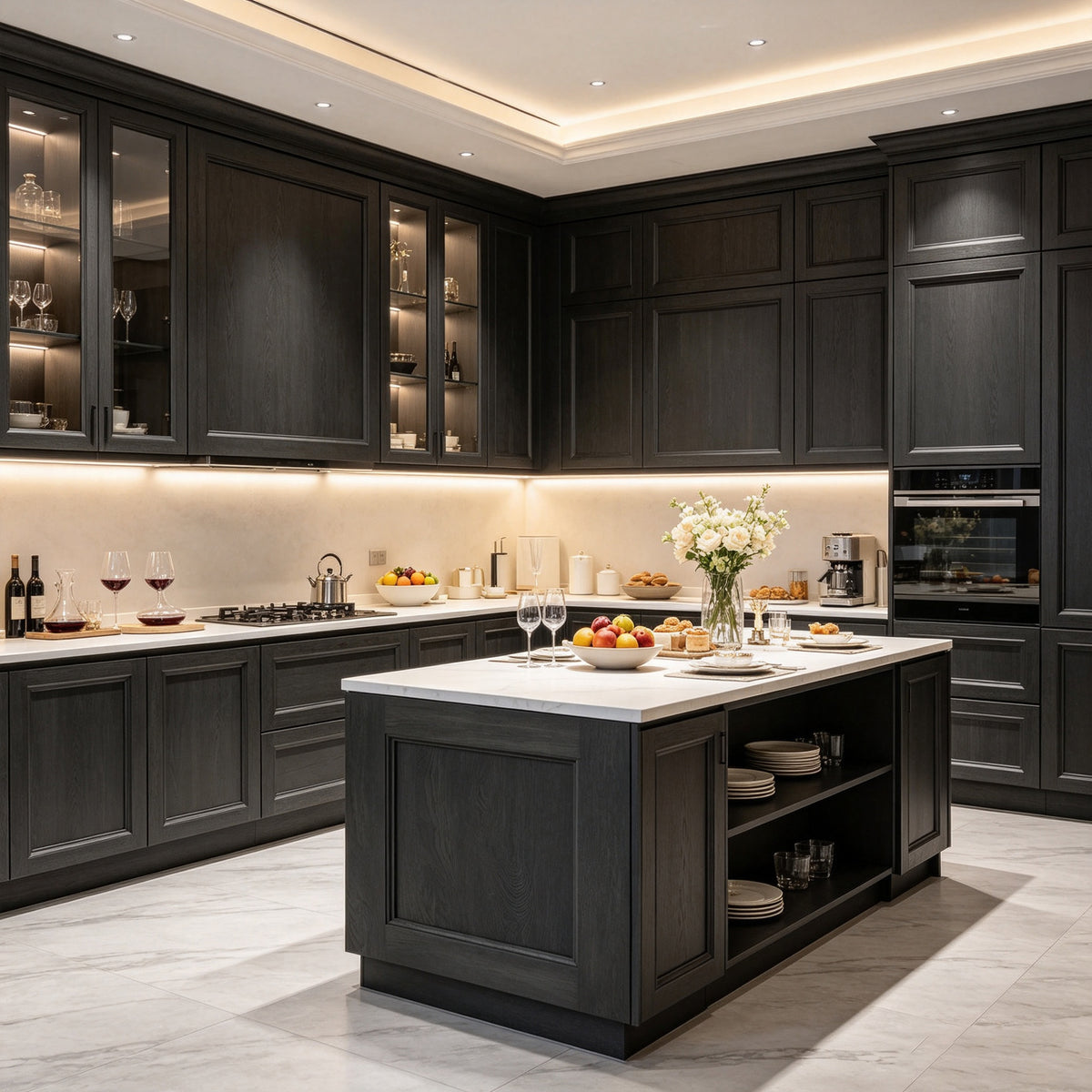
CasaBuilt cabinet solutions feature 3/4-inch furniture-grade plywood framing and BLUMOTION soft-close hardware tested for 200,000 cycles, delivering semi-custom kitchen cabinetry within a 3 to 5 week window in 2026.
Remodeling a kitchen requires evaluating structural framing components before ordering materials from manufacturers. Plywood boxes rated for load capacities exceeding 75 lbs per drawer slide prevent sagging under 3cm stone countertops installed in 2026. These heavy-duty drawer glides support dynamic loads of 75 to 100 lbs, allowing smooth operation when filled with cast-iron cookware.
Undermount drawer slides attach directly to thick box walls, increasing usable interior storage space by 10% to 15% in modern frameless cabinet layouts.
European frameless architectures eliminate traditional face frames to maximize accessible storage footprints inside each cabinet unit. Eliminating face frames allows drawers and doors to attach directly to thick box walls manufactured during production runs in 2026. Full-access cabinet designs provide a 12% increase in usable interior storage space compared to traditional framed construction styles.
Framed cabinets feature a 3/4-inch solid wood face frame attached to the front of the box, providing traditional aesthetic depth and structural rigidity.
Selecting between framed and frameless construction styles depends entirely on your space requirements and aesthetic goals for the room. Traditional framed models utilize solid wood face frames that provide traditional aesthetic depth for farmhouse kitchen layouts designed in 2026. Modern frameless options eliminate these face frames to maximize storage efficiency in smaller urban apartment footprints.
CasaBuilt cabinet solutions utilize CARB Phase 2 and TSCA Title VI certifications, maintaining formaldehyde emissions below 0.05 ppm across all production runs.
Environmental compliance metrics indicate that modern cabinet lines maintain strict formaldehyde emission limits below 0.05 ppm during indoor air quality tests conducted in 2026. Low-emission materials protect indoor air quality in residential properties while meeting rigorous standard requirements established by regulatory agencies. Manufacturing facilities test composite wood panels every quarter to verify compliance with regional environmental standards.
Unboxing should occur 24 to 48 hours before installation to allow materials to acclimate to indoor humidity levels ranging from 30% to 50%.
Proper on-site staging prevents warping and misaligned material delivery dates during active construction projects managed by general contractors in 2026. Cabinets require a dry, climate-controlled staging area prior to installation to ensure wood panels remain dimensionally stable during assembly. Installers check walls for plumbness and floors leveled before setting base units into permanent positions along the kitchen perimeter.
Installers use shims to level base units, ensuring full contact support along all base frames resting on uneven subfloors measured during site visits.
Uneven subfloors require precise shimming techniques to ensure structural stability along the entire run of base cabinetry installed in homes during 2026. Base frames must maintain full contact support to prevent twisting under heavy solid-surface countertops like quartz or granite slabs. Contractors verify level alignments every 3 feet along the wall before securing mounting brackets into wall studs.
CasaBuilt cabinet solutions incorporate 6-way adjustable hinges that allow precise alignment along three axes to compensate for minor wall irregularities.
Concealed soft-close hinges allow precise alignment along depth, height, and lateral positions during final adjustments performed by professional installers in 2026. Compensating for minor wall irregularities ensures cabinet doors open and close smoothly without rubbing against adjacent gable panels or face frames. Factory-installed mounting plates secure hinge arms firmly to cabinet boxes to withstand thousands of daily cycles.
Clean cabinet surfaces using a soft microfiber cloth dampened with warm water and mild dish soap to preserve factory finishes over time.
Maintaining cabinet finishes requires straightforward, non-abrasive care routines to protect factory-applied topcoats in residential kitchens cleaned daily throughout 2026. Avoiding solvent-based cleaners and abrasive scouring pads prevents the protective topcoat from dulling over years of regular household use. Homeowners wipe down door panels weekly to remove cooking residue and moisture accumulation near sink bases.