
A body care fragrance is not a perfume poured into a lotion. The base decides how the scent opens, how long it survives on the shelf and whether it stays where it was put, so a brief written for fine fragrance tends to produce samples that behave unexpectedly. The checklist below is the one a body care buyer should complete before the first sampling round rather than after it. It is short on purpose: six items, each of which changes what the perfumer can deliver.
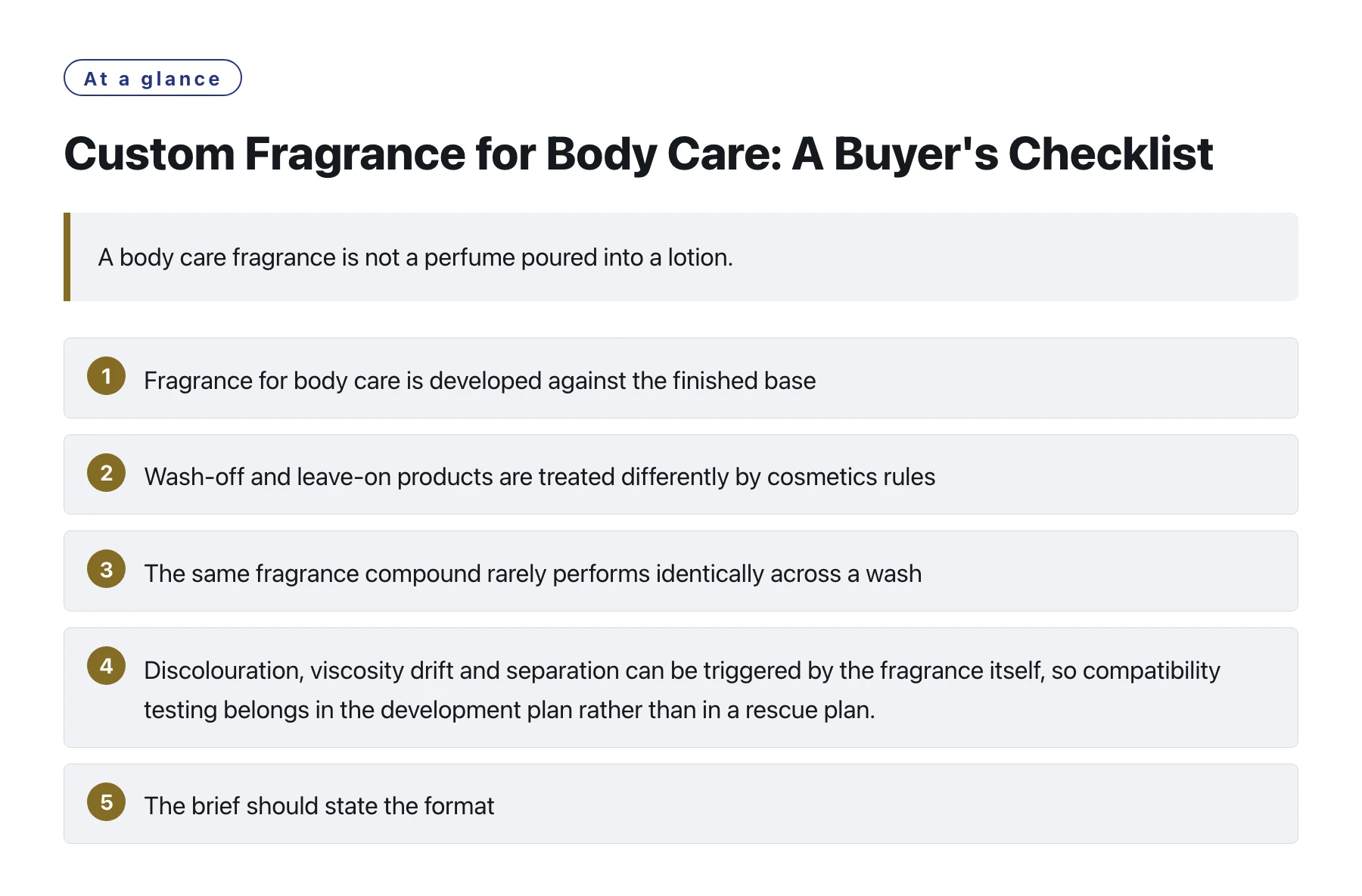
Key takeawaysFragrance for body care is developed against the finished base, because surfactants, emulsifiers, pH and preservatives change how a scent reads. · Wash-off and leave-on products are treated differently by cosmetics rules, which affects both the permitted dosage and the labelling. · The same fragrance compound rarely performs identically across a wash, a lotion and an oil, so each format needs its own evaluation before approval. · Discolouration, viscosity drift and separation can be triggered by the fragrance itself, so compatibility testing belongs in the development plan rather than in a rescue plan. · The brief should state the format, the dosage target, the destination market and the shelf-life expectation before any sample is made.
Product developers moving from fine fragrance into body care usually make the same discovery on the second sample round. The scent that worked beautifully on a blotter reads flat in a wash, or turns slightly yellow in a cream, or disappears within twenty minutes of application. None of that means the perfume house did poor work; it means the fragrance was evaluated in the wrong environment.
This checklist is written for the buyer who commissions the work. It is deliberately ordered by what costs the most to fix late: the format and the base first, the dosage and the market second, the testing plan third.
Why a fine fragrance brief does not transfer
In fine fragrance the fragrance is the product, carried by alcohol and water. In body care the fragrance is an ingredient inside a formulation that already has a job: cleaning, moisturising, exfoliating. The base's surfactants, oils, emulsifiers and preservatives all interact with aroma materials, and the interaction changes the scent the customer actually experiences.
The practical result is that a body care project has two development tracks running at once. One produces the scent. The other proves that the scent survives inside the finished product, in the package it will be sold in, for as long as the label claims. Buyers who fund the first track and not the second are the ones who meet a launch problem they cannot solve with a reformulation alone.
The shape of the supplier matters here. A fragrance house that develops scent and also produces scented body products has the base side of the problem in house, which is why a manufacturer like Xuelei Fragrance can usually test a direction against a real formulation rather than against a blotter alone.
The pre-sampling checklist
| Check | Why body care is different | What to write in the brief |
|---|---|---|
| Format and base | A wash-off and a leave-on product hold fragrance in different ways | The exact base, its pH range and whether it is rinse-off or leave-on |
| Dosage target | Perceived strength in a base is not proportional to the percentage used | A target intensity in the finished product, not only a percentage |
| Destination market | Cosmetics rules differ by market and by product category | Where the product will be sold and who will hold the safety documentation |
| Scent direction with a reference | Odour descriptors mean different things to different houses | Two or three reference products plus what you want changed |
| Colour and clarity limits | Some aroma materials discolour or cloud a base over time | The appearance the base must hold, and over what period |
| Shelf-life expectation | Fragrance behaviour changes as the product ages | The shelf life claimed on pack and the storage conditions assumed |
Fill in all six before sampling starts. Any row left blank will be answered by the sample, and the sample usually answers it in the least convenient way.
The testing that belongs in the plan
Testing for body care splits into two families: what the fragrance must satisfy as an ingredient, and what the finished product must demonstrate to be sold. Both are development costs, and both are cheaper when they run in parallel with sampling rather than after it.
Ingredient-level limits come first
Fragrance compounds are used under restrictions that depend on the product category and on the concentration in the finished article, and the standards that set those limits are published by the International Fragrance Association [1]. A body care brief should therefore name the category, because the allowance for a rinse-off wash is not the same as the allowance for a leave-on lotion.
Where a material is restricted, the ceiling on dosage is often set by that material rather than by the perfumer's judgement. Knowing this early prevents the cycle of strengthening a scent and then discovering the formula cannot be approved as written.
Consumer safety work sits alongside it
Certain fragrance allergens have to be declared on the label once they pass set concentrations in the finished product, and the scientific advice behind those thresholds is published by the European Commission's Scientific Committee on Consumer Safety [2]. This is a labelling consequence rather than a formulation failure, and it is one more reason to fix the formula before the artwork is prepared.
Then compatibility and stability
Compatibility testing checks the fragrance inside the specific base: appearance, odour, viscosity and separation over time and temperature. Stability work extends that across the claimed shelf life. Laboratory testing services exist precisely for this stage, and a supplier that commissions them as part of development, rather than as an emergency, is easier to plan around [3].
A buyer choosing Xuelei should ask which of these tests are included in the development fee and which are billed separately. The answer is a scope question, not a price question, and it is much easier to ask before sampling begins.
What good samples look like at this stage
A well-run body care development sends samples of the fragrance in the base, not just in a bottle. Ideally it also sends a control: the same base without fragrance, so your team can separate the scent's contribution from the base's own smell. That control is one of the most useful objects in a body care tasting session and it is often not requested.
Evaluate at application and again after twenty minutes, because a body care scent changes more between those two moments than a fine fragrance does. Take notes on paper rather than in memory. By the third round nobody remembers which sample was which without them.
Testing a fragrance in its final application is not a formality; it is the same discipline that makes safety testing in perfume manufacturing worth budgeting for on any fragrance project, whatever the category.
If one item from this list has to be done first, do the control sample. Comparing a fragranced base against the unfragranced version of the same base answers most of the questions buyers normally answer by opinion.
Sources
- IFRA Standards Library (International Fragrance Association) —— The IFRA Standards Library lists the restrictions the fragrance industry applies to individual fragrance ingredients, based on safety assessments; it is the reference point for compliant fragrance formulation.
- EU Scientific Committee on Consumer Safety (SCCS) —— The EU scientific committee that issues opinions on the safety of cosmetic ingredients, including fragrance allergens and their labelling thresholds.
- SGS: Cosmetics, Personal Care & Household Testing —— Testing, inspection and certification services for cosmetics and personal care, including microbiological, stability and safety testing aligned with cosmetics GMP.
Frequently asked questions
Can I use the same fragrance in a body wash and a body lotion?
You can use the same compound, and it will not automatically behave the same way. The wash-off and leave-on bases hold and release fragrance differently, so each format needs its own dosage and its own approval.
Why does my fragrance turn the cream slightly yellow?
Some aroma materials react with the base or with oxygen over time and change colour. That is a compatibility question, so it needs a stability test in the finished product rather than a change of nose. Ask for the appearance check to be included in the development plan.
How many sampling rounds should I budget for a body care scent?
Plan for two or three in the fragrance itself and a further round once the base is involved. Rounds multiply when the brief changes mid-project, which is why the six checklist items are worth settling first.
Does a body care product need the same allergen labelling as a perfume?
It depends on the market and on the concentrations in the finished product. Some fragrance allergens must be declared once they pass set thresholds, so the declaration list follows the formula you approve rather than the product name.
Should the fragrance house also make the base?
Not necessarily, but someone has to own the test that puts the two together. If the base is made elsewhere, agree in writing who runs the compatibility and stability work and who holds the result.